
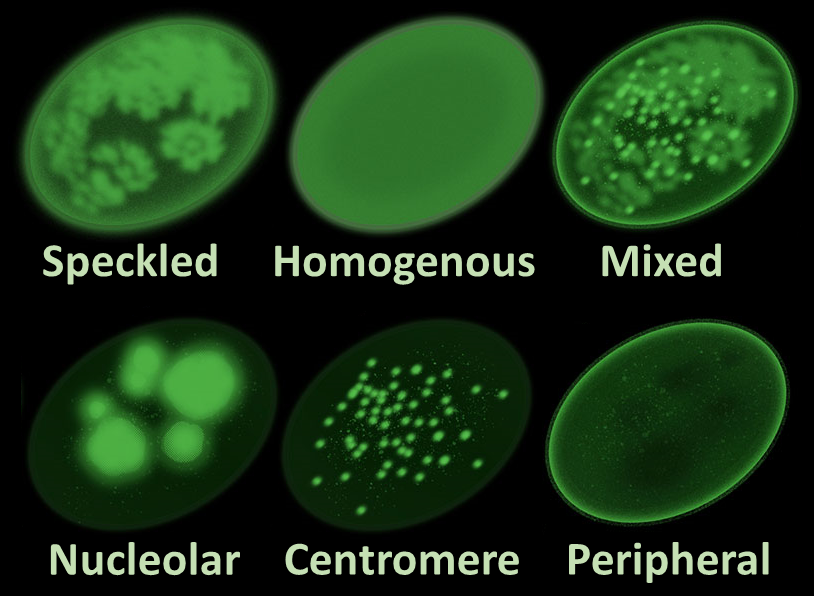
Description
Antinuclear antibodies (ANA), also known as antinuclear factors (ANF), are autoantibodies that target components of the cell nucleus. Indirect immunofluorescence assay (IFA) on HEp-2 cells is a common method used to detect and characterize ANA. In this assay, patient serum is incubated with HEp-2 cells on a slide. If ANA are present in the serum, they bind to the nuclear antigens in the HEp-2 cells. After washing away unbound antibodies, fluorescently labeled secondary antibodies are applied, which bind to the ANA-antigen complexes. Under a fluorescent microscope, the presence of fluorescence in the cell nuclei indicates a positive ANA result.
The dilution refers to the dilution factor at which the patient’s serum is tested in the assay. ANA titers are reported as reciprocal dilutions (e.g., 1:40, 1:80, 1:160, etc.). A titer of 1:40 or higher is typically considered positive for ANA, but the interpretation also depends on the pattern of fluorescence observed (e.g., homogeneous, speckled, nucleolar, etc.) and the patient’s clinical symptoms.
Different dilutions may be tested depending on the laboratory’s protocol and the suspected autoimmune condition. Typically, initial screening is done at a lower dilution (e.g., 1:40), and if positive, further dilutions may be tested to determine the endpoint titer, which is the highest dilution at which fluorescence is still observed. This endpoint titer can provide additional information about disease activity and severity.

Reviews
There are no reviews yet.